
AI Decision Support
Predicts conflicts, suggests
clearances, and helps controllers
act faster and safer.

Our AI ATC system combines real-time data, advanced AI,
and human expertise to manage manned and unmanned traffic —
from traditional aircraft to next-generation BVLOS drones.
WeatherCAVOK 18°C
Wind270° 12 kt
AirspaceClass C / D
From real-time surveillance to intelligent decision support,
our platform enhances safety, efficiency, and capacity
— on the ground and in the sky.
Predicts conflicts, suggests
clearances, and helps controllers
act faster and safer.
Handles both manned aircraft
and BVLOS drones in the
same airspace.
Built with aviation standards,
redundancy, and real-time
risk monitoring.
From regional airports to
national airspace and
future air mobility.
REAL-WORLD IMPACT
 Developed in Jordan
About AI ATC
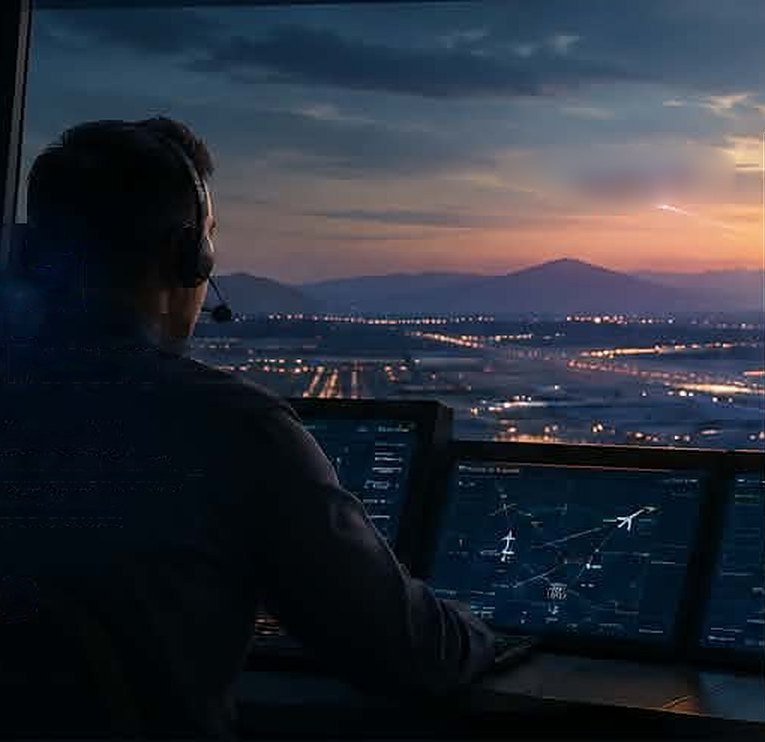
AI ATC is an air traffic control decision-support platform developed in Jordan. It combines real-time data and advanced AI with human expertise, so controllers can manage manned aircraft and BVLOS drones in one picture, with clarity and confidence.
Our mission: to help air navigation service providers handle more traffic, and more kinds of traffic, without compromising safety.
Human in the loopThe platform suggests. The controller issues every clearance.
Explainable by designEach suggestion shows the traffic, the data and the reasoning behind it.
Designed to degrade gracefullyIf the AI or a data feed drops out, controllers carry on with their existing systems and procedures.
Capabilities
Each capability supports the controller's judgment. None of them replaces it.
Flags potential losses of separation early, using projected trajectories as well as current positions.
Proposes resolution options that the controller can accept, amend or ignore.
Shows manned aircraft and BVLOS drones together in one fused air picture.
Keeps live exchanges between controllers and pilots structured and traceable.
Keeps weather, airspace structure and active restrictions in view for every decision.
Monitors the whole picture continuously and raises what needs attention, in order of priority.
Tracks ground movements and runway occupancy to support safe sequencing.
Records every suggestion and every decision, so any session can be replayed and reviewed.
How it works
Five steps turn many data sources into one picture and a set of options. The controller has the final say.
Every step is logged, so each suggestion and each decision can be traced and replayed.
Established aviation data sources, standards and guidance. Listing them does not imply certification or compliance.
Surveillance
Unmanned traffic
Flight & aeronautical
Weather
Communications
AI governance
The interfaces listed are design targets. Integration is scoped with each ANSP.
AI ATC is a decision-support tool, not a decision maker. It detects, predicts and proposes, and the controller issues every clearance. If the AI or a data feed becomes unavailable, the platform is designed to degrade gracefully, and controllers continue with their existing systems.
Use cases in depth
Traffic keeps growing, and every extra movement adds to controller workload.
How AI ATC helps
Outcome: Helps deliver smoother flow and more capacity from the same airspace, with controllers firmly in command.
FAQ
No. AI ATC is a decision-support tool. It detects, predicts and suggests, and qualified controllers stay in command and issue every clearance.
Manned aircraft, BVLOS drones and ground movements, shown together in one air picture. It is designed to extend to eVTOL and other advanced air mobility aircraft.
It is designed around established aviation sources: ADS-B, Mode S and primary radar for surveillance, Remote ID and U-space services for drones, flight plans and NOTAMs, and METAR and TAF for weather. The exact integration is scoped with each ANSP.
Every suggestion is advisory, explained and logged, and existing safety nets such as STCA stay in place. If the AI or a data feed becomes unavailable, the platform is designed to degrade gracefully, and controllers continue with their existing systems and procedures.
AI ATC is developed in Jordan and is still in development. It is not certified or approved for operational use. It is designed with EASA's guidance for Level 1 AI (assistance to the human) in mind. Any operational use would need approval from the relevant authority, which in Jordan is the Civil Aviation Regulatory Commission (CARC).
Get in touch using the form below. We start with a walkthrough on simulated traffic. Any trial is then shaped around your airspace, data and procedures, and runs in shadow mode, with no input to live operations.
Contact
Request a demo, discuss a trial, or ask us anything about AI ATC.
Developed in JordanServing airports and airspace in the region and beyond.
Demos on simulated trafficAny trial runs in shadow mode, with no input to live operations.
See how AI ATC supports controllers on simulated traffic, away from live operations.